The problem
Crop symptoms can be difficult to identify consistently from visual inspection alone, while a raw machine-learning notebook does not provide the workflow, history, guidance, or usability needed by non-technical users.
Building the experience
Loading projects, engineering decisions, and product details.
AI-Assisted Web Application
Applied AI portfolio projectA crop disease decision-support application combining image classification, prediction history, user accounts, feedback workflows, an AI assistant, and administrator tools in a responsive Flask interface.
My role
Full-stack & ML integration developer
Core stack
Python · Flask · TensorFlow
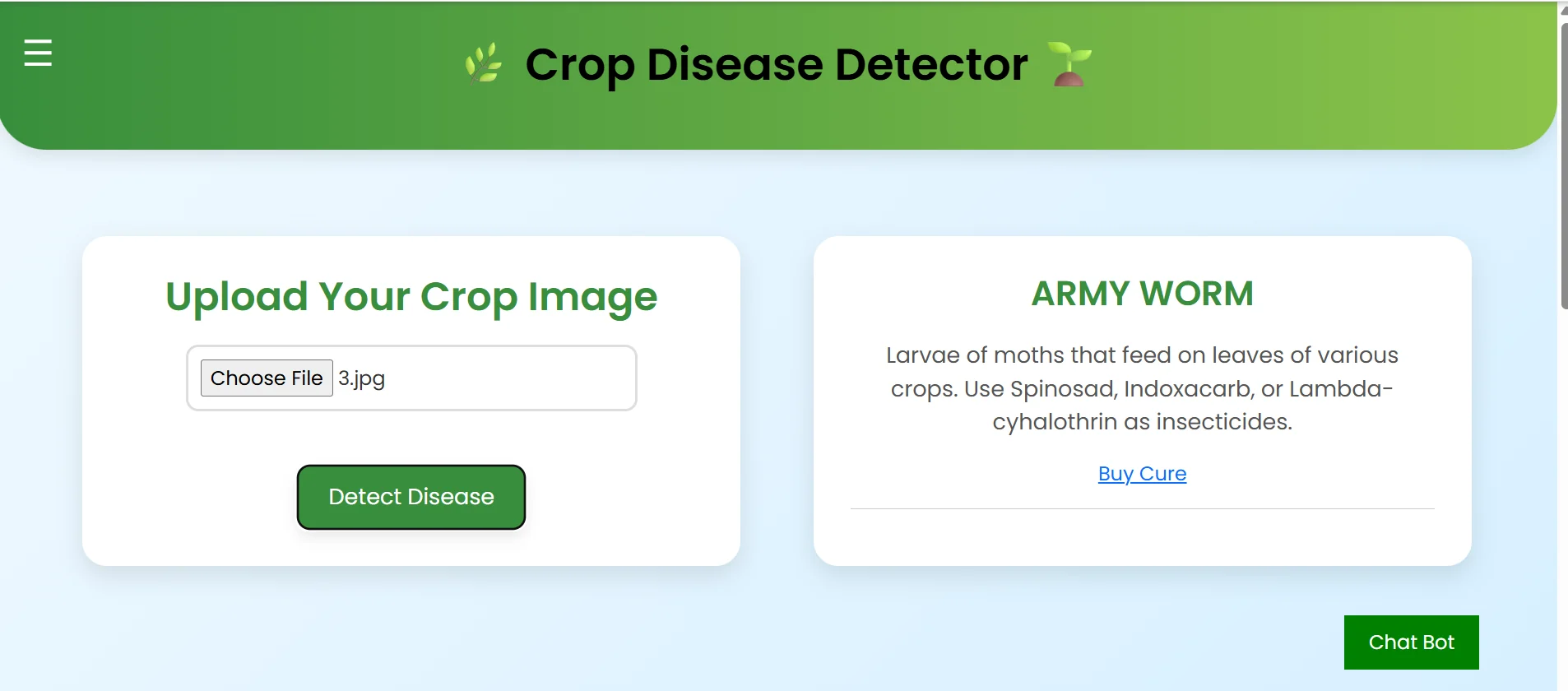
The problem
Crop symptoms can be difficult to identify consistently from visual inspection alone, while a raw machine-learning notebook does not provide the workflow, history, guidance, or usability needed by non-technical users.
The solution
I connected the model workflow to a responsive Flask application with authentication, upload/camera support, prediction history, decision-support messaging, feedback collection, administration tools, and database-backed user workflows.
Project overview
CropGuard AI connects a trained image-classification workflow to a practical web application. Users can upload or capture crop images, receive model predictions and guidance, review detection history, and interact with supporting tools while administrators manage feedback and application data.
Responsive product view
The same product is presented across desktop, tablet, and phone frames to show how the interface adapts, not just how it looks in one screenshot.
desktop
tablet
phone
A clear delivery path from the user interface through application logic to data and external services.
Lessons learned
Next case study